A route sells you a minimum before it sells you a kilogram
Nobody is charged by the gram. A route quotes a first weight with a price on it, then charges a fixed amount for each repeating unit above that. Those two numbers, plus a flat handling fee, are the whole of a shipping quote.
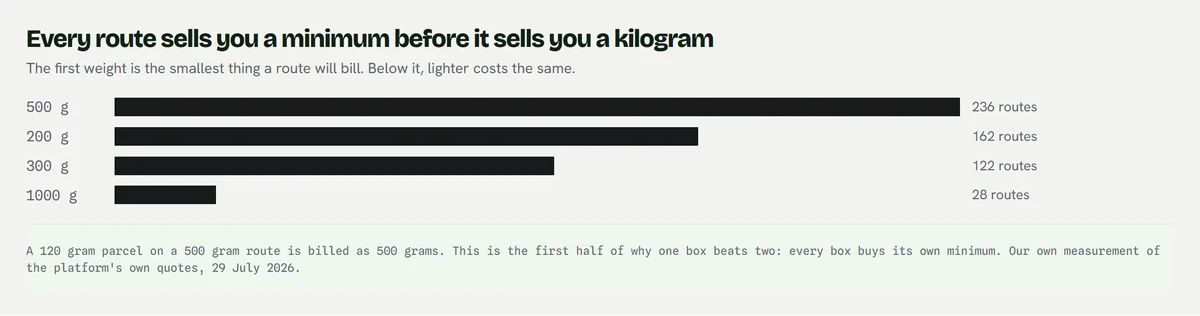
So the first consequence is immediate: a very light parcel costs what the first weight costs. Sending 120 grams on a route whose first weight is 500 grams is sending 500 grams. That minimum is also why a second box is expensive, because the second box buys its own.
The most common minimum in the quotes we recomputed, on 236 routes. Below it, lighter does not mean cheaper.
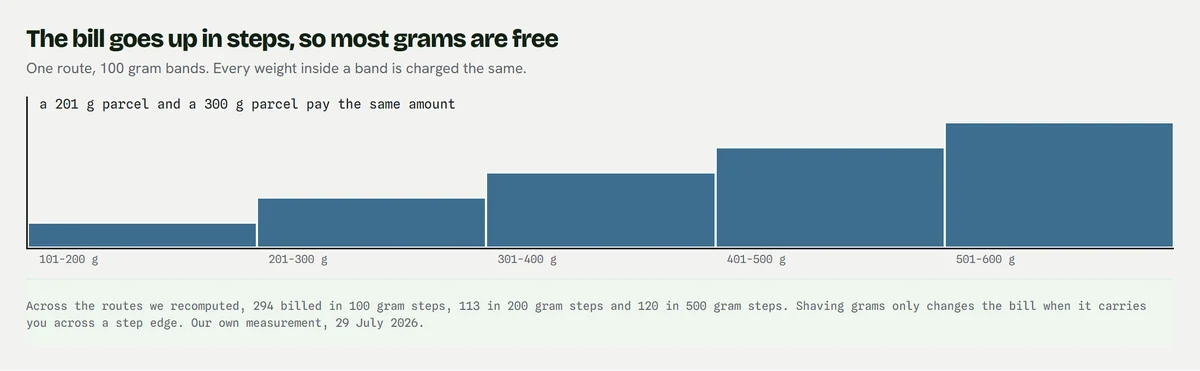
The most common step, on 294 routes. Everything inside one step is charged the same amount.
100 gthe edge
Everything between two edges costs the same
Picture the route as a ruler with a thick line at the first weight and a tick every unit after it. Your parcel lands somewhere on that ruler, and the bill is decided by which tick it has passed, not by where exactly it sits between two of them.
Which means the useful question is never how much the parcel weighs. It is how far it is from the next tick.
A route with a 500 gram first weight and 500 gram units, drawn to four kilograms. The highlighted band is one step: a 1,501 gram parcel and a 2,000 gram parcel pay the same.
The two moments when shaving weight is worth the trouble
Most of the time it is not. Removing a hang tag from a parcel sitting in the middle of a band changes nothing at all. There are exactly two cases where it does.
When you are just over an edge
If the parcel is 20 grams past a tick, those 20 grams are costing a whole unit. That is the moment a removed shoebox or a stripped-out carton pays for itself, and it is worth asking the warehouse for a rehearsal to find out before you commit.
When the overestimate is large enough to come back
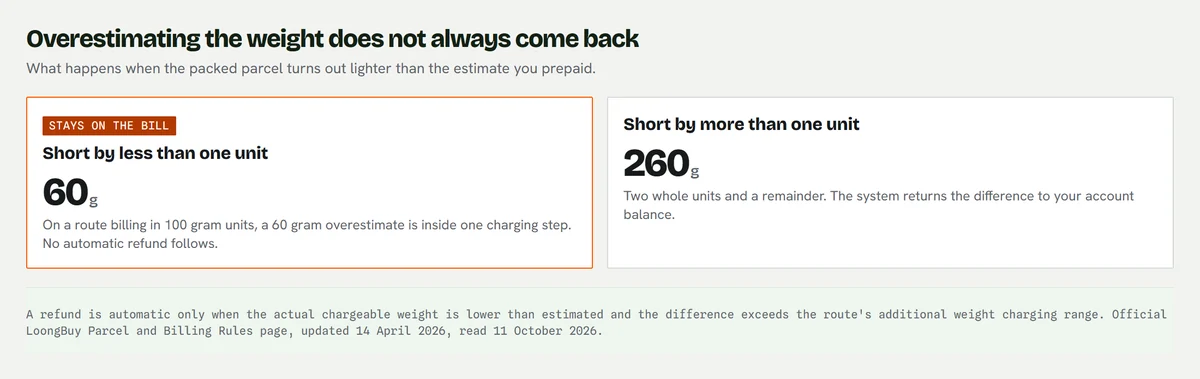
If you prepaid on an estimate and the packed parcel came in lighter, the system refunds the difference automatically only when that difference is bigger than the route's additional weight charging range. A 60 gram overestimate on a 100 gram route stays on the bill.
Everywhere else, spend the effort on volume instead
If volumetric weight is the number ahead, grams are irrelevant by definition. Cubic centimetres are what the carrier is converting, and compressing or unboxing moves those in much larger quantities than removing labels moves grams.
What each kind of item does at an edge
A reading of the five groups from the point of view of one decision: you are close to a tick and deciding what else goes in.
| Add | Typical effect | At an edge |
|---|---|---|
| Jewellery, a watch strap, a cap | Tens of grams, almost no volume | Safe. These are what you use to fill a band you have already paid for. |
| T-shirts, jerseys | A couple of hundred grams each, very little volume | Usually safe, but two or three of them will cross a 500 gram tick between them. |
| A hoodie, a bag, a cap with structure | Light, but hundreds of cubic centimetres | Irrelevant to the gram count and possibly decisive for the volumetric one. |
| Jeans, boots, a belt | Half a kilogram or more each | One piece can cross a tick on its own. Check the gap first. |
| Anything in a rigid retail box | Moderate weight, large fixed volume | Ask whether the box can come off before you decide anything about grams. |