Per kilogram, a big parcel is cheaper. Up to a point.
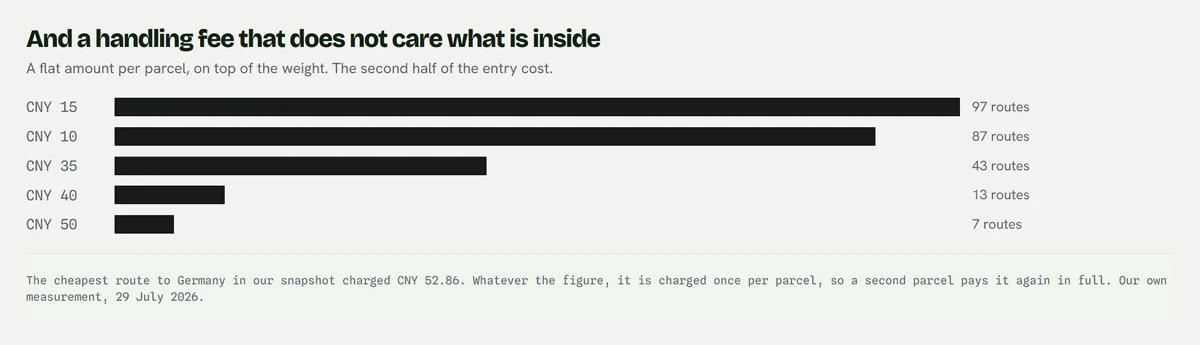
The reason combining works is not generosity. It is that each parcel pays a minimum and a flat handling fee before it carries anything, and those two costs do not shrink when the parcel is small. Spread over ten kilograms they almost disappear; over half a kilogram they are most of the bill.
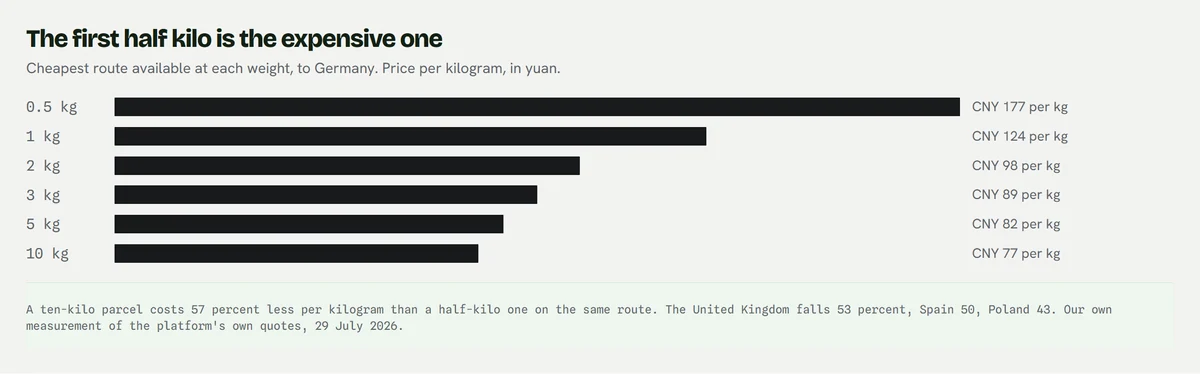
On the cheapest route to Germany in our snapshot, a half kilo parcel worked out at about CNY 177 per kilogram and a ten kilo parcel at about CNY 77. Same route, same day, same rule. The United Kingdom fell 53 percent over the same span, Spain 50, Poland 43.
Most of what you are paying is the minimum and the handling fee, divided by very little weight.
The same fixed costs, spread over twenty times as much. A fall of 57 percent on that route.
2xentry cost
What exactly the second box pays twice
Not a share of the first box's bill. A whole first weight, and a whole handling fee, charged again from zero.
Added to the box you already have
+71CNY
Ten more one hundred gram units at CNY 7.14 each. The minimum and the handling fee were paid when the parcel was created, so they are not charged again.
Sent as a parcel of its own
124CNY
The same ten units, plus the first weight and the handling fee a second time. On this route that is CNY 52.86 of handling alone.
5 kgthe turn
And the weight where combining stops paying
This is the part the usual advice leaves out. The curve above only falls while the cheap route is still willing to carry the parcel. When it drops out, the next route up takes over, and the price per kilogram can go back up past where it started.
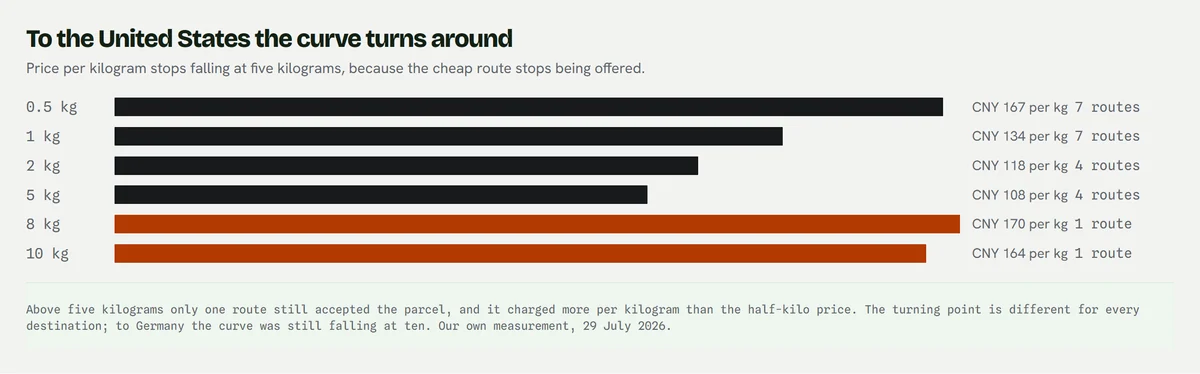
To the United States the curve turned around at five kilograms
In our snapshot the cheapest line stopped being offered above five kilograms. Price per kilogram fell from about CNY 167 to about CNY 108 and then rose to about CNY 170 at eight kilograms, which is worse per kilogram than the half kilo parcel it started from.
The number of routes collapses before the price moves
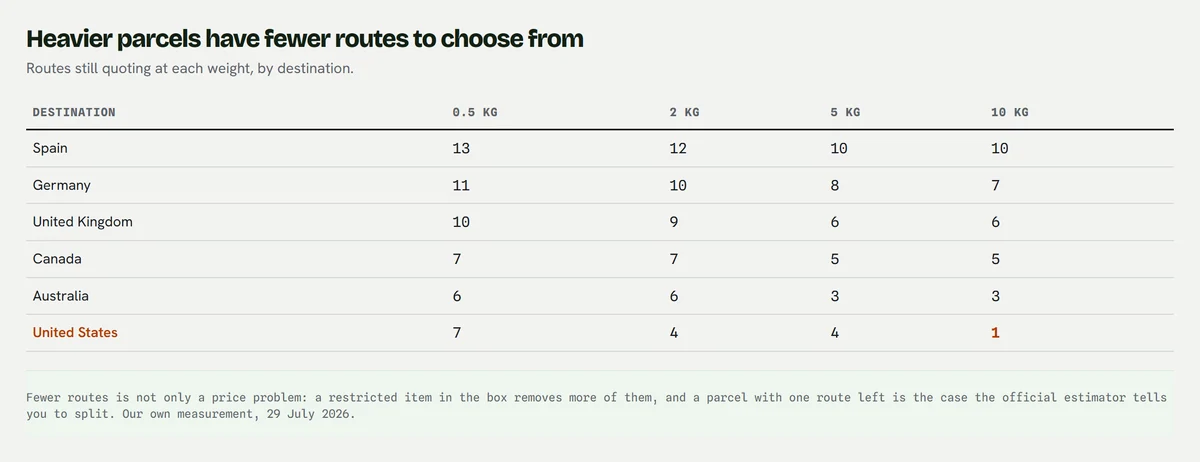
To the United States the count went from seven routes at a kilogram to four at two, and to one at eight. One remaining route is also the situation the official estimator describes as the moment to split a large parcel into smaller ones.
The turning point belongs to the destination, not to the rule
To Germany, the United Kingdom and the Netherlands the curve was still falling at ten kilograms. There is no universal best weight, which is why this guide gives you the shape rather than a number to aim at.
Customs pulls the same way
Independently of price, the official Customs and Taxes page lists parcels over roughly ten kilograms among the things that raise inspection probability, and recommends keeping below that and splitting large shipments.
How many routes are still quoting as the parcel gets heavier
Fewer routes is not only a price problem. A restricted item removes more of them again, and the last route standing is rarely the cheap one.
| Destination | 0.5 kg | 2 kg | 5 kg | 10 kg |
|---|---|---|---|---|
| Spain | 13 | 12 | 10 | 10 |
| Germany | 11 | 10 | 8 | 7 |
| United Kingdom | 10 | 9 | 6 | 6 |
| Canada | 7 | 7 | 5 | 5 |
| Australia | 6 | 6 | 3 | 3 |
| United States | 7 | 4 | 4 | 1 |
So the honest rule is a range, not a target
Combine until one of three things happens: the cheap route for your destination stops quoting, the parcel passes the weight at which the official pages say inspection gets more likely, or the oldest item in the warehouse runs out of free days. Whichever arrives first is your answer, and all three are specific to you.
What never changes is the shape underneath. One box pays one minimum and one handling fee. Two boxes pay two of each, and nothing you do to the contents changes that.
The third limit: how long the box can wait