Chargeable weight: the greater of two numbers, not an average of them
Every parcel has two weights. One is measured, one is calculated, and the carrier bills whichever is larger. Nothing in between matters, which is why a box can be cheap to post and expensive to ship.
The measured one is simple: the warehouse weighs what it packed, including the carton. The calculated one is where the money hides, because it depends on a divisor that belongs to the route rather than to the parcel.
Volumetric Weight = Length x Width x Height / Volumetric Divisor
Official LoongBuy Parcel and Billing Rules page, updated 14 April 2026 · read 11 October 2026
The goods, their original packaging, the outer carton and the packing material, weighed after the parcel is finally packed.
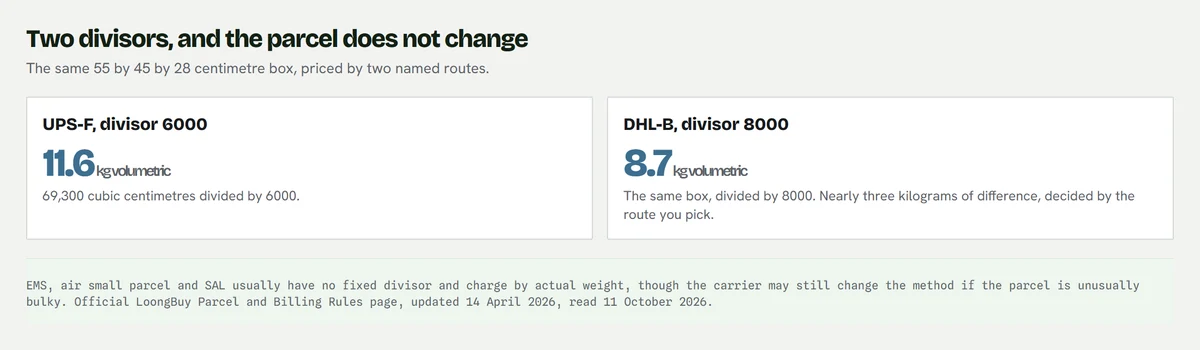
The same box at 55 by 45 by 28 centimetres, divided by a route divisor of 8000. Nothing about the contents enters it.
6000divisors
Which divisor applies, and where there is none
Only two divisors are named on the official page, each attached to a named line. The third row is the one people forget: some routes do not compute a volumetric weight at all, which makes them the right answer for a box full of air.
| Route | Divisor | What it means for a bulky box |
|---|---|---|
| UPS-F | 6000 | The harsher of the two. A 69,300 cubic centimetre box becomes 11.6 kg before anything is weighed. |
| DHL-B | 8000 | The same box becomes 8.7 kg. Nearly three kilograms of difference decided by the route, not by you. |
| EMS, air small parcel, SAL | usually none | Normally charged on actual weight, though the page notes the carrier may still change the method if the parcel is unusually bulky. |
Finding the item that is setting your bill
When volumetric weight wins, it is rarely the whole box that did it. Usually one object with a rigid shape or a lot of loft is responsible for most of the cubic centimetres, and removing or compressing that one object moves the number more than removing three others.
Work in cubic centimetres, not impressions
3numbers
Multiply each item's packed length, width and height. The biggest product is your candidate, and it is often not the heaviest thing in the box.
Then ask what the warehouse can do to it
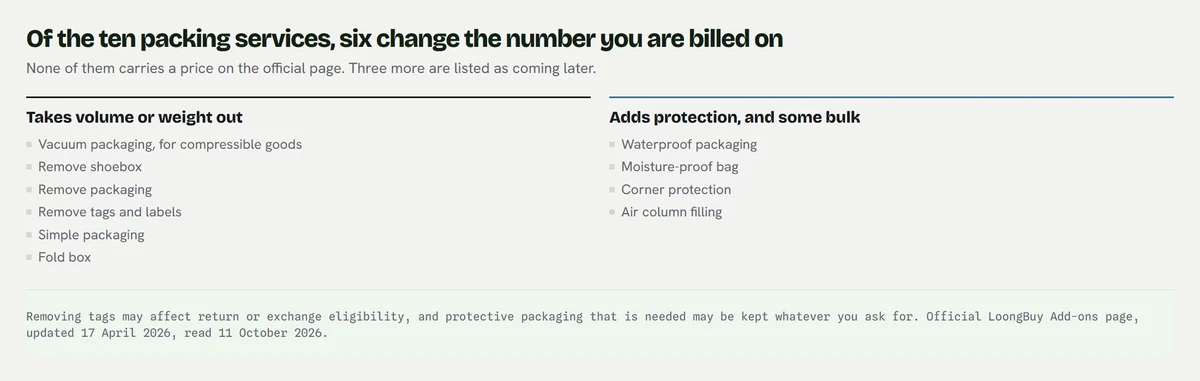
6services
Six of the ten packing services on the official list exist to take volume or weight out. Vacuum packing works on loft; removing a shoebox works on rigid shape. Neither helps a camera lens.
Four habits that keep the calculated weight down
None of them is a trick. They are the four places where a decision you make early turns into a number later.
Decide the bulky item first
A coat, a bag or a pair of boots sets the floor for the whole box. Everything else is fitted around it, so choose it before you fill the gaps rather than after.
Buy soft things to fill rigid gaps
A shoebox leaves usable space at its corners. T-shirts and jerseys cost grams and no volume, which is the cheapest way to use room you have already paid for.
Ask for the box to be opened up
Removing a shoebox, folding a box flat or stripping unnecessary outer packaging are all named services. They change the dimensions the carrier measures, which is the only input to the calculated weight.
Check the route before you optimise for it
Optimising volume on a route that bills by actual weight wastes your effort, and optimising weight on a 6000 divisor route wastes the box. The divisor decides which effort pays.