90 dthe window
Free storage is counted per item, and it has already started
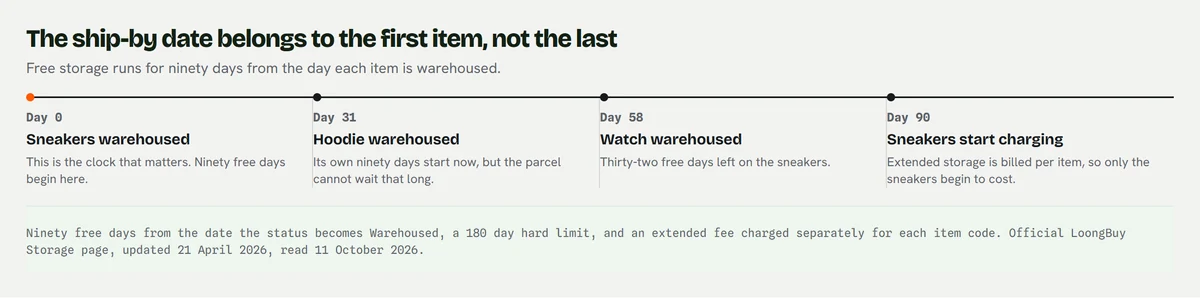
An agent warehouse is not a locker you rent. Each item gets its own free period, counted from the day its order status becomes Warehoused, and the parcel you are building has to leave before the oldest of them runs out.
That turns a storage policy into a scheduling problem. A haul assembled over six weeks does not have ninety days left when the last thing lands. It has ninety minus however long the first thing has been sitting there, and nothing you do later gives those days back.
Counted from the date the status becomes Warehoused. Reminders usually go out before it ends.
Still not submitted at 180 days with no instruction from you, and the item is treated as abandoned.
What the clock actually does while you shop
Four consequences, in the order a first haul meets them.
Choosing a seller is a scheduling decision as much as a price one
Not the slowest shop, the earliest one, sets the deadline. If one dispatches in two days and another takes three weeks, the fast shop is the one eating your window, because its item has been sitting in the warehouse the whole time.
So when two listings are close on price, the dispatch record is worth more than the difference. A seller who ships late costs you nothing; a seller who ships early, at the start of a six week build, costs you a month of your free period.
Adding one more thing late is not free
It costs nothing in storage for the new item and it can cost the whole buffer on the oldest one. The question to ask before a late addition is not whether you want it but how many days the earliest item has left.
The fee is per item, so it is smaller than people expect
After the free period the extended fee is charged separately for each item code at RMB 0.1 per kilogram per day, with a minimum of RMB 0.1 per item per day, and for bulky goods the chargeable weight uses a volumetric factor of 8000.
Which makes waiting cheaper than a second box, usually
Thirty extra days on a one kilogram item is RMB 3. Sixty days on a five kilogram item is RMB 30. A second parcel repeats a first weight and a handling fee, which on the routes we recomputed was tens of yuan before it carried anything.

The dates the official page actually commits to
Four rows, each one from the Storage page. The third is the one most people never meet and the one with no safety net.
| Case | Clock starts | Length | What happens at the end |
|---|---|---|---|
| A normal warehoused item | The date the status becomes Warehoused | 90 days free | Extended fee begins, charged per item. Reminders usually go out before this point. |
| Any item, overall | Same | 180 days maximum | Still unsubmitted with no response and it is regarded as abandoned, with disposal and ownership passing to the platform. |
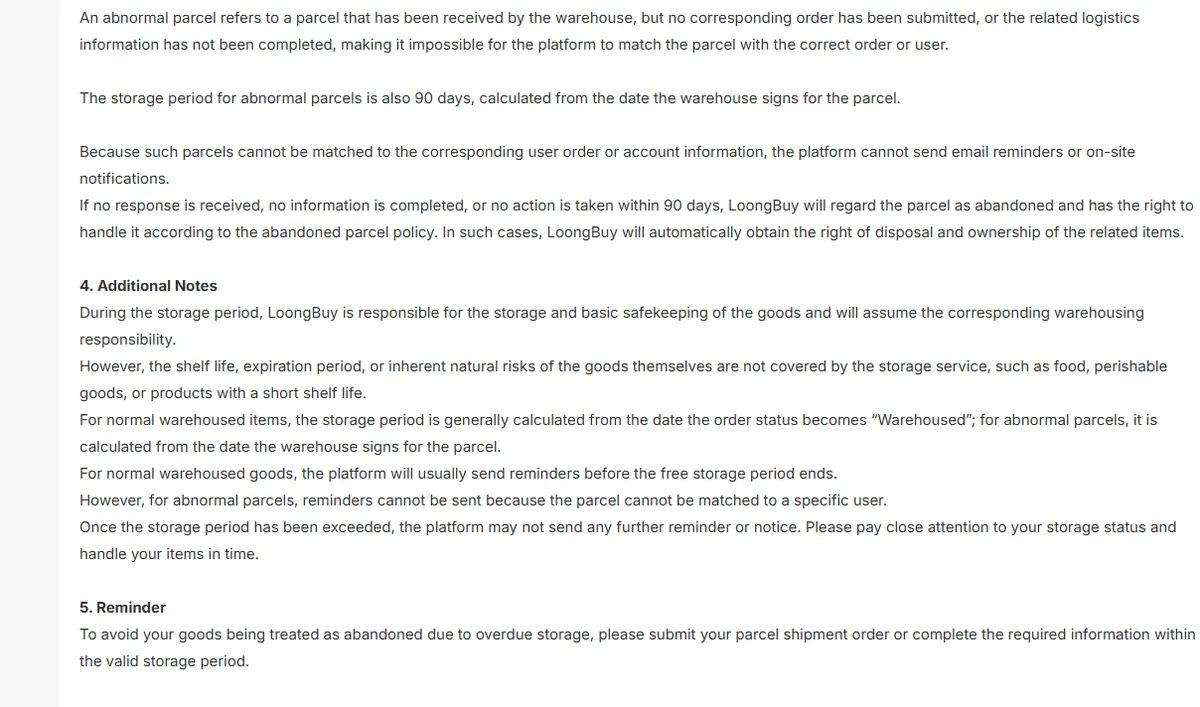
| An abnormal parcel | The date the warehouse signs for it | 90 days | The same outcome, except that because the parcel cannot be matched to an account, no reminder can be sent at all. |
| Goods with a short shelf life | Same as a normal item | unchanged | Storage covers safekeeping but not shelf life, expiry or the inherent risks of the goods themselves. |

Two ways to run out of time, and only one of them warns you
The difference is whether the warehouse can tell whose parcel it is.
A normal order
90days
Tied to your account, so the platform usually sends a reminder before the free period ends. After that it may send nothing further, so the reminder is not a safety net you can rely on twice.
A parcel it cannot match
90days
Received but with no corresponding order submitted, or with incomplete logistics information. The clock runs from the date of signature and no email or on-site notification is possible.